What to Expect at Faith in Christ UMC
What to Expect at Faith in Christ UMC
Explore the welcoming spirit of Faith in Christ UMC, where our Sunday services are designed to inspire, connect, and nurture your faith journey.
Discover What Awaits You at Faith in Christ UMC
Here you’ll find helpful details about parking, dress, worship style, participation, communion, and membership to help you feel at home. Get a glimpse of what to expect when you join us for Sunday worship — from easy, welcoming parking to meaningful fellowship.

Where can I park when I arrive for the service?
There is ample parking available in our church lot and nearby designated areas, all clearly marked to ensure easy access.
We have a parking lot at the rear of the church building with spaces reserved for visitors. Handicapped parking is also available in this lot and on the South Church Street side of the building. Additional street parking is available on Second Street.
What is the typical attire for Sunday services?
There is no dress code at Faith in Christ UMC. You can wear any clothing that’s socially acceptable and comfortable. We want you to feel welcomed and wear what works for you.
What happens during the service?
Sunday services at FiCUMC are mostly traditional. Music includes mostly traditional hymns, as well as an anthem by our chancel choir and/or special music. We have a children’s time near the beginning of our service, after which younger kids have the opportunity to retire to “Children’s Church” or return to sit with their families. The main message is usually about 15-20 minutes long. Communion is offered on appropriate Holy days and on the first Sunday of each month (see below for details). We close our service with a hymn and a blessing.
How can I participate during the service?
Singing during service is a way for the congregation to participate in the service and is a great way to worship God. If you’re not comfortable with singing, though, you’re not required to sing during communal hymns.
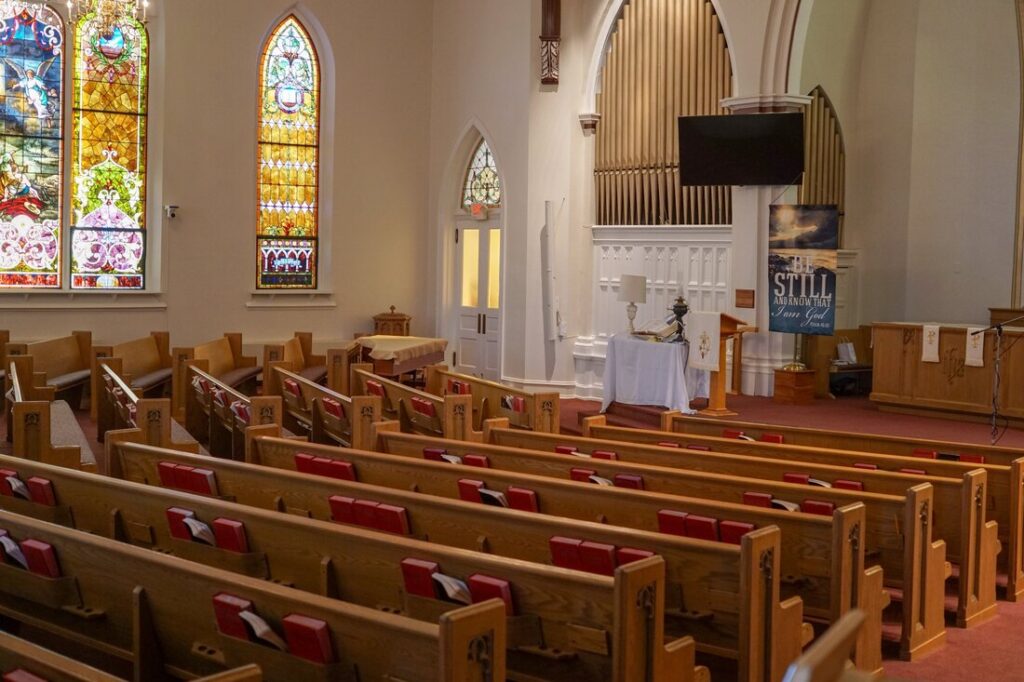
We have Revised Standard Version Bibles in the hymnal racks in every pew for those who need or want one during service.
Although God loves a cheerful giver, tithes and offerings are not a requirement. Give what you can, when you can, if you can.
Does the church offer communion, and how is it conducted?
We celebrate Holy Communion on the first Sunday of every month. Because of the gracious nature of Holy Communion, it is open to all. (You do not have to be a member of our church, a Methodist, or a member of any church to receive communion.) We receive Holy Communion is a variety of ways and each one is meaningful. Christ teaches patience and acceptance, so if you don’t feel comfortable partaking in this most Holy of rituals you are more than welcomed to observe only.
If you have problems moving and would like to receive Communion in your seat, please tell an usher prior to the beginning of service and it will be brought to you.
Do I have to become a member?
There is no requirement that you become a member of our church. You are welcome as often as you would like to attend. If, however, you feel you are ready to become a member, the first step is to talk with our Pastor. He will explain the process to you and make the appropriate arrangements.
Becoming a member is a simple and meaningful journey. Those interested in joining begin by participating in membership classes, where you can explore the Christian faith, learn about United Methodist beliefs, and share your own faith story with our pastor. When you’re ready, you join the church through a Profession of Faith (or reaffirmation/transfer, depending on your background) during a Sunday morning worship service, where the congregation welcomes you into the life and ministry of Faith in Christ UMC.
What is Methodism?
The United Methodist Church is a 12.6-million-strong global church that opens hearts, opens minds and open doors through active engagement with our world.
John Wesley and the early Methodists placed primary emphasis on Christian living, on putting faith and love into action. This emphasis on what Wesley referred to as “practical divinity” has continued to be a hallmark of United Methodism today.